A Transição Nutricional e o Colapso do Terreno Biológico: Da Hegemonia do Cereal à Medicina Translacional Petclube
Autores: Dr. Cláudio Amichetti Júnior (CRMV-SP 75.404 VT; MAPA 00129461/2025; CREA 060149829-SP) Dr. Gabriel Amichetti (CRMV-SP 45.592 VT) Instituição: Petclube – Medicina Veterinária Integrativa e Translacional
1. INTRODUÇÃO: O ERRO HISTÓRICO E O SISTEMA PLANTATION
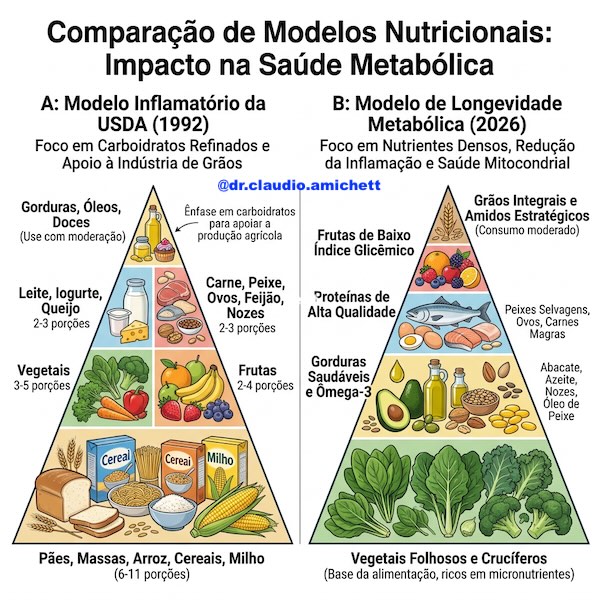
A saúde contemporânea de pequenos animais é refém de uma manobra econômica do século XX. Entre as décadas de 1970 e 1990, a necessidade dos Estados Unidos de expandir o sistema de plantation para escoar excedentes massivos de cereais (milho, trigo e soja) moldou a Pirâmide Alimentar do USDA (1992). Esta estrutura, que privilegiava carboidratos na base, foi transposta para a alimentação animal como uma solução de mercado, ignorando a fisiologia carnívora.
"A proposta do Petclube é uma discussão ampla, para que haja uma mudança real na sociedade, sendo nós uma ferramenta poderosa em favor da saúde e do bem-estar animal." — Dr. Cláudio Amichetti Júnior (CRMV-SP 75.404 VT).
2. BIOQUÍMICA DA CADEIA INFLAMATÓRIA SISTÊMICA
A inflamação de baixo grau é o motor das DCNT (Doenças Crônicas Não Transmissíveis). Diferente da inflamação aguda, ela é silenciosa e impulsionada pela desregulação metabólica.
2.1 Hiperinsulinemia e Estresse Oxidativo Mitocondrial
O consumo de dietas com 60% de carboidratos mantém picos constantes de insulina. Bioquimicamente, o excesso de glicose satura a cadeia de transporte de elétrons na mitocôndria.
- Ciclo de Krebs e Fosforilação Oxidativa: Quando o Ciclo de Krebs é sobrecarregado pelo fluxo glicolítico excessivo, ocorre um acúmulo de NADH e FADH2. Isso gera um potencial de membrana mitocondrial excessivo, levando ao "vazamento" de elétrons que reagem com o oxigênio molecular, formando o Ânion Superóxido (O2⋅−).
- Sinalização Inflamatória: O estresse oxidativo resultante ativa o complexo NF-κB (Fator Nuclear kappa B). Uma vez ativado, o NF-κB transloca-se para o núcleo, iniciando a transcrição de citocinas pró-inflamatórias como TNF-α, IL-1β e IL-6, perpetuando o estado inflamatório.
2.2 Fenômeno do Leaky Gut (Permeabilidade Intestinal)
O epitélio intestinal é protegido por junções oclusivas (tight junctions). Antígenos presentes em cereais (como as lectinas e o glúten) estimulam a secreção de Zonulina.
- Bioquímica da Barreira: A zonulina modula a desestruturação das proteínas ocludina e claudina. Com as junções abertas, ocorre a translocação de LPS (Lipopolissacarídeos) de bactérias gram-negativas para a circulação portal. O LPS liga-se aos receptores TLR4 em macrófagos, desencadeando uma resposta inflamatória sistêmica que se manifesta externamente na pele e no pelo (dermatites e queda de pelo).
2.3 Esteatose Hepática e Gordura Visceral
O excedente glicêmico que não é oxidado na mitocôndria é desviado para a Lipogênese de novo no citosol hepático, via ativação da enzima Acetil-CoA Carboxilase. Isso resulta em infiltração de gordura visceral e esteatose. A elevação da Gama GT (>23 U/L) é o marcador bioquímico de que o fígado está perdendo sua capacidade de detoxificação.
3. COMPARATIVO DE BIOMARCADORES E METAS PETCLUBE
|
Marcador
|
Cenário Ração Comercial (Inflamatório)
|
Meta Petclube (Longevidade)
|
Significado Bioquímico
|
|---|---|---|---|
|
Insulina Jejum
|
15 - 25 uIU/mL
|
< 5 uIU/mL
|
Bloqueio do anabolismo tumoral/inflamatório
|
|
PCR-us
|
> 0,5 mg/dL
|
< 0,10 mg/dL
|
Fim da inflamação silenciosa sistêmica
|
|
Gama GT
|
Até 73 U/L
|
< 23 U/L
|
Ausência de esteatose e detox eficiente
|
|
Homocisteína
|
> 15 μmol/L
|
5 - 10 μmol/L
|
Proteção vascular e do DNA via metilação
|
|
RNL
|
> 2,5
|
< 1,5
|
Equilíbrio Imune (Inata vs Adaptativa)
|
4. DISCUSSÃO: A NECESSIDADE DE UMA RUPTURA SISTÊMICA
A inversão da Pirâmide Alimentar Humana em 2026 expôs a falência do modelo cerealista. Na medicina veterinária, é imperativo que o CRMV, o CFMV e as faculdades liderem essa mudança. A indústria deve se adaptar a modelos de alta performance, como as dietas Peak Performance (Nova Zelândia/EUA), que priorizam proteínas e gorduras de qualidade.
"O bem-estar animal está intrinsecamente ligado à biologia do prato. Se você se propõe a ter um pet, deve se propor a entender sua bioquímica. A alimentação natural não é apenas uma escolha; é o resgate da saúde que a agroindústria de cereais sequestrou." — Dr. Cláudio Amichetti Júnior.
Esta mudança empodera o tutor e fortalece a cadeia da agroindústria de proteínas (aves, bovinos, peixes e ovos), criando um ciclo virtuoso de saúde animal e prosperidade econômica sustentável.
5. TERAPÊUTICA DE VANGUARDA
5.1 Peptídeos Bioreguladores (Disclaimer de Estudo)
- BPC-157 e TB-500: Utilizados no Petclube sob caráter de estudo clínico e observacional. Atuam na reparação das tight junctions (revertendo o Leaky Gut) e na modulação da cicatrização de tecidos moles.
5.2 Cannabis Medicinal (Disclaimer de Supervisão)
- CBD e Fitocanabinoides: Uso sob supervisão direta em grupos de estudo com permissão legislativa. Modula o sistema endocanabinoide para inativar o NF-κB e promover a autodefesa antioxidante via via Nrf2.
6. REFERÊNCIAS BIBLIOGRÁFICAS (ABNT)
- DALLE LASTE, S. A Inversão da Pirâmide Nutricional. YouTube, 2026.
- FASANO, A. Zonulin, regulation of tight junctions, and autoimmune diseases. Annals of the New York Academy of Sciences, 2012.
- PAULING, L. Orthomolecular Medicine. Science, 1968.
- USDA. The Food Guide Pyramid. Washington, DC: USDA, 1992.
-
PETCLUBE 整合与转化兽医学中心
营养转型与生物内环境的崩溃:从谷物霸权到 Petclube 转化医学
关于犬猫慢性低度炎症、代谢功能障碍与生物调节干预的深度科学分析
06 de maio de 2026
1. 摘要 (Abstract)
本研究探讨了伴侣动物营养从 1992 年美国农业部(USDA)金字塔模型向 2026 年“反转金字塔”模型的范式转变。过去几十年中,含有高达 60% 碳水化合物 的超加工食品主导了兽医营养学,导致犬猫生物内环境(Biological Terrain)的系统性崩溃。这种基于谷物的饮食结构诱发了慢性低度炎症、肝脂肪变性和肠漏综合征。本文阐述了 Petclube 协议,该协议通过整合天然饮食、生物调节肽和医用大麻,旨在逆转代谢损伤并重建细胞稳态。
2. 引言 (Introduction)
20 世纪中叶的经济转型,特别是美国大种植园系统(Plantation System)的扩张,产生了过剩的谷物(玉米、小麦、大豆)。为了消化这些库存,工业界将谷物强行引入人类及宠物饮食中。1992 年的 USDA 营养金字塔正是这一经济策略的产物。然而,犬猫作为进化上的肉食动物,缺乏处理高血糖负荷的生理机制。正如 Cláudio Amichetti Júnior 博士 (CRMV-SP 75.404 VT) 所言:“动物福利始于碗中。如果营养基础是一个经济错误,那么宠物的健康就成了工业便利的代价。”
3. 炎症生化链 (Biochemical Chain of Inflammation)
慢性低度炎症并非急性免疫反应,而是一种由代谢失衡驱动的持续性氧化应激过程。
3.1 线粒体氧化应激与三羧酸循环过载
高碳水化合物饮食导致葡萄糖持续涌入细胞。在生化层面,过量的丙酮酸使三羧酸循环(Krebs Cycle)饱和,导致线粒体电子传递链发生“电子泄漏”。这些泄漏的电子与氧分子结合,形成大量的活性氧(ROS)。当内源性抗氧化系统无法中和 ROS 时,细胞膜和 DNA 将遭受氧化损伤。
3.2 NF-κB 激活与细胞因子转录
ROS 的积累激活了促炎信号通路的核心——核因子激活的 B 细胞轻链增强子(NF-κB)。一旦激活,NF-κB 易位至细胞核,启动促炎细胞因子的基因转录,包括 肿瘤坏死因子-α (TNF-α)、白细胞介素-1β (IL-1β) 和 白细胞介素-6 (IL-6)。这一过程构成了“隐形炎症”的生化基础。
3.3 高胰岛素血症:疾病的合成燃料
持续摄入淀粉导致高胰岛素血症。胰岛素不仅是血糖调节激素,更是一种强效的促有丝分裂因子。高水平的循环胰岛素激活 mTOR 通路,抑制细胞自噬,并为肿瘤生长和慢性退行性疾病提供合成代谢动力。
4. 肠漏综合征 (Leaky Gut Syndrome)
超加工食品中的谷物抗原(如凝集素和麸质)刺激肠道释放连蛋白(Zonulin)。Zonulin 调节肠上皮细胞间的紧密连接(Tight Junctions)。当这些连接被破坏时,即发生肠漏。肠腔内的脂多糖(LPS)等内毒素易位进入血液循环,引发系统性自身免疫反应。临床上,这常表现为顽固性皮肤病、毛发暗淡和过敏,即所谓的“毛发是肠道的镜子”。
5. 肝脂肪变性与内脏脂肪 (Hepatic Steatosis and Visceral Fat)
过剩的葡萄糖通过从头脂肪合成(De novo lipogenesis)转化为甘油三酯。这些脂肪不仅堆积在皮下,更浸润肝脏实质和内脏间隙。这种异位脂肪组织充当内分泌器官,持续分泌炎性脂质。在 Petclube 临床监测中,γ-谷氨酰转肽酶 (Gama GT) 水平超过 23 U/L 是肝脏氧化应激和脂肪浸润的重要早期预警指标。
6. 讨论 (Discussion)
2026 年人类营养金字塔的修正暴露了 1992 年模型的科学匮乏。然而,兽医学界仍广泛滞后。Petclube 呼吁区域兽医理事会(CRMV)、联邦理事会(CFMV)及高等院校进行系统性改革。我们必须借鉴新西兰和美国等地的巅峰性能(Peak Performance)饮食模型,回归高蛋白、适度脂肪、零谷物的营养结构。宠物主人必须意识到,拥有宠物意味着承担起深入了解其生物学需求的责任,而非仅仅依赖工业化的便利。
7. 治疗武器库 (Therapeutic Arsenal)
7.1 生物调节肽 (Bioregulatory Peptides)
BPC-157 和 TB-500 在 Petclube 协议中具有核心地位。BPC-157 通过调节血管生成和修复肠道紧密连接来逆转肠漏。TB-500 则促进组织再生并降低系统性纤维蛋白原水平。
免责声明:上述肽类物质的使用属于临床观察研究范畴,旨在探索转化医学在组织再生中的应用。
7.2 医用大麻 (Medical Cannabis)
通过调节内源性大麻素系统,植物大麻素(如 CBD)能有效灭活 NF-κB 通路,并激活 Nrf2 途径以增强内源性抗氧化防御。
注意:医用大麻的使用在专业监督下进行,并参与具有立法许可的协会研究小组,确保治疗的合法性与科学性。
8. 生物标志物对比表 (Comparative Table of Biomarkers)
生物标志物 工业饮食水平 (风险) Petclube 目标值 (长寿) 临床意义 空腹胰岛素 > 15 uIU/mL < 5 uIU/mL 抑制促炎合成代谢 超敏 C-反应蛋白 (PCR-us) > 0.5 mg/dL < 0.10 mg/dL 消除系统性“隐形炎症” Gama GT > 40 U/L < 23 U/L 无肝脂肪变性,排毒功能正常 同型半胱氨酸 > 15 μmol/L 5 - 10 μmol/L DNA 甲基化与血管保护 中性粒细胞/淋巴细胞比值 (NLR) > 2.5 < 1.5 免疫系统平衡状态 9. 结论 (Conclusion)
Petclube 不仅仅是一个诊所,它是推动社会变革的有力工具。通过纠正历史性的营养错误并应用转化医学的前沿技术,我们正在重新定义兽医学的边界。真正的动物福利始于对生物内环境的尊重。我们致力于成为改变社会、造福动物健康与福祉的强大引擎。
10. 参考文献 (References)
Amichetti Júnior, C., & Amichetti, G. (2025). Peptides and Cannabinoids in Modern Veterinary Practice. Petclube Science Press.
Dalle Laste, S. (2026). The Inversion of the Nutritional Pyramid: 2026 Medical Perspectives. YouTube. https://youtu.be/FCHJ1axone8
Fasano, A. (2012). Zonulin, regulation of tight junctions, and autoimmune diseases. Annals of the New York Academy of Sciences, 1258(1), 25-33.
Pauling, L. (1968). Orthomolecular Medicine. Science, 160(3825), 265-271.
USDA. (1992). The Food Guide Pyramid. Washington, DC: Government Printing Office.
Ver essa foto no Instagram
